
Researchers
Prof. Dr. J. Andrés Guerra Torres (Coordinator)

Characterization of optical and light emission properties of rare earth doped wide band-gap semiconductors. Research on optical properties of dielectric thin films by VASE and spectrophotometry. Modeling optical properties of crystalline and amorphous semiconductors. Research on the amorphous SiC:H for photo-catalysis of water.
Prof. Dr.-Ing. Rolf Grieseler

Investigation of multi layer systems, optical and mechanical properties of ceramics and semiconductors and MEMs structures.
Prof. Dr. J. Amaru Palomino Töfflinger
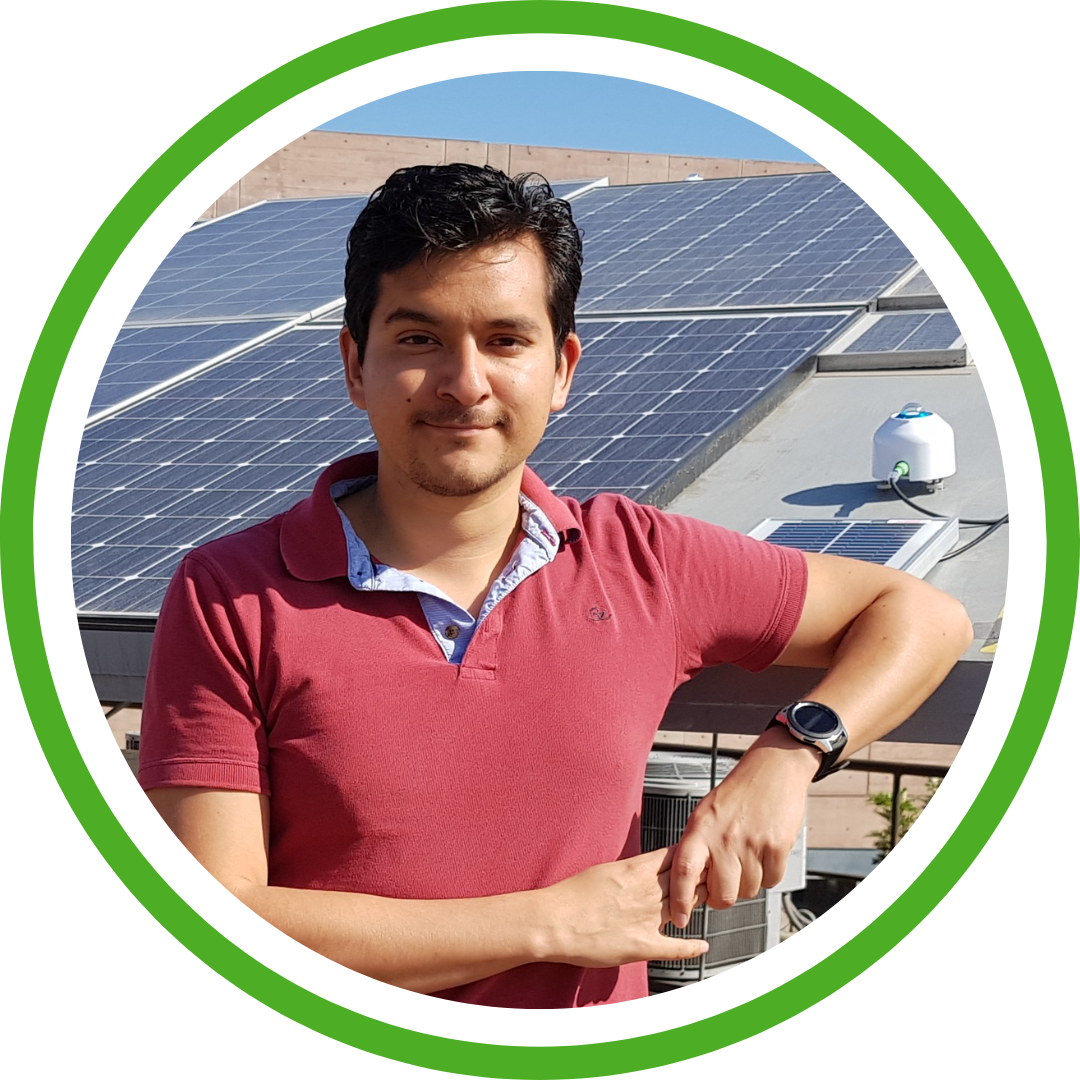
Prof Dr. Investigation of passivation materials for silicon solar cells in cooperation with the Helmholtz-Zentrum Berlin (HZB) and the Technische Universität (TU) Ilmenau. The investigated materials include AlN and SiN on silicon wafers and SiON on laser-crystallized silicon.
In development: Modeling of PV system energy-generation and characterization of different PV module technologies in cooperation with the Universidad de Jaen (UJA), Spain.
japalominot@pucp.edu.pe
amaru.toefflinger@helmholtz-berlin.de
Prof. Dr. Eleodoro Flores Merino
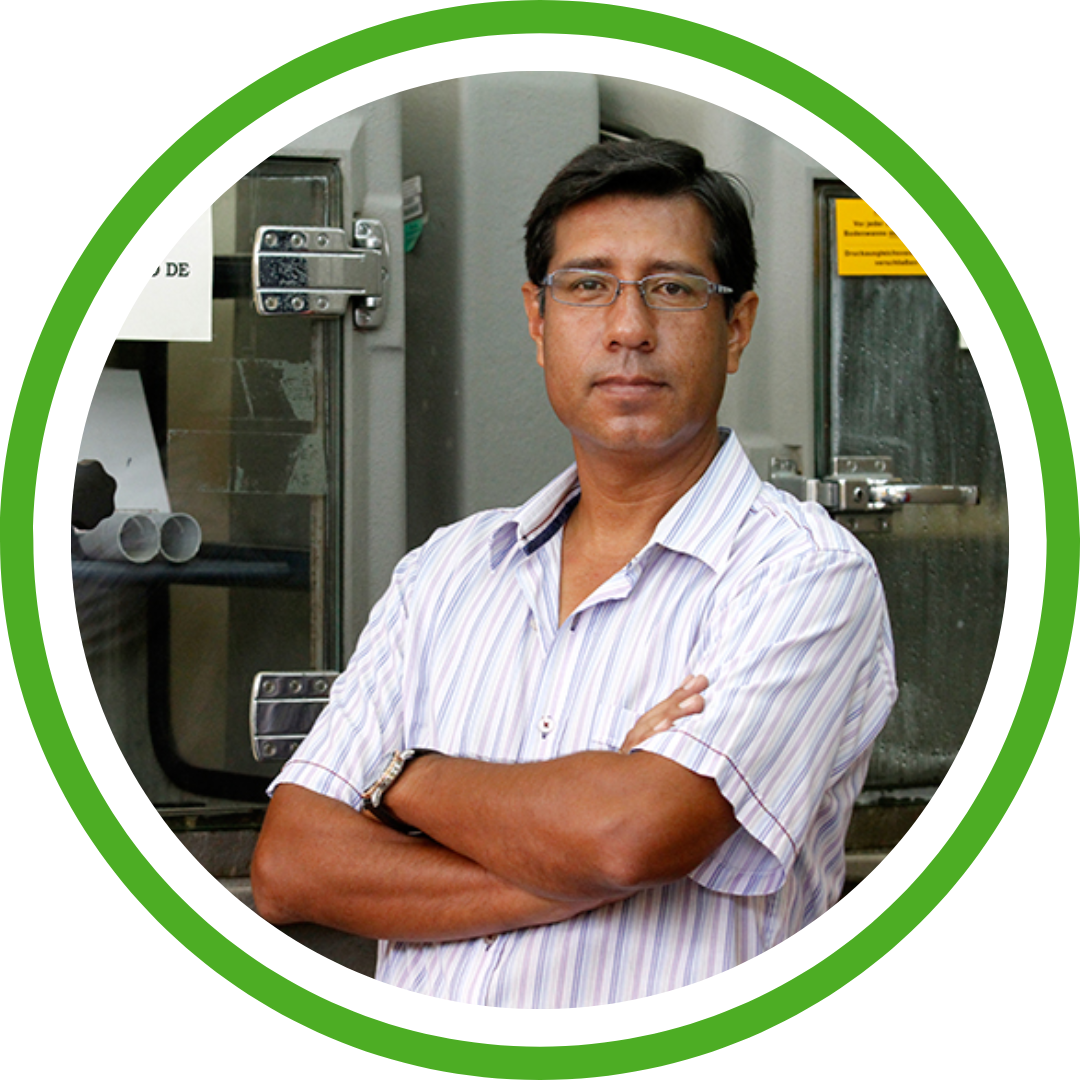
Principal Professor TC of the Department of Engineering of the PUCP. Graduated from the specialty of Chemical Sciences of the PUCP. Master’s and Doctoral Studies in Materials Science and Chemical Sciences at the Complutense University of Madrid and specialization in corrosion at the Center for Metallurgical Research of Madrid (CENIM). Knowledge in corrosion and prevention of corrosion, atmospheric corrosion, anticorrosive paints (tests and formulation) and management of quality systems (ISO 17025).
Prof. Msc. M. Karina Camargo León

Researcher in the area of materials science with knowledge of electrochemistry and science of colloids. Experience in synthesis of metallic coatings and composites by chemical and electrochemical methods, analysis and characterization of materials, colloidal dispersions as well as the study of corrosion in materials.
Prof. Dr. F. Aurelio Rumiche Zapata

Mechanical Engineer (PUCP). Master of Science and Doctor of Philosophy in Materials Engineering (University of Illinois at Chicago). Professor of Materials Science and Engineering – PUCP Engineering Department. Member of the Academic Committee PUCP. Coordinator of Accreditation and Continuous Improvement of the Mechanical Engineering Section. Director of the Master in Welding Engineering. Experience in the development of research projects in the area of nanostructured materials and materials for biomedical applications. Coordinator of the Materials Characterization Center PUCP and Senior Analyst in the CITE Materials. Specialist in Failure Analysis of Mechanical Components.
Prof. Dr. Maria del Rosario Sun Kou

PhD in chemical sciences in the field of heterogeneous catalysis; with postdoctoral studies on the subject of adsorbents, carried out at the University of Leuven (Belgium). Master in Chemical Engineering awarded by the UNI. He is currently a member of the Steering Committee of the Ibero-American Federation of Catalysis (FISOCAT). The line of research that is developed focuses on the issue of environmental control through the use of absorbents and synthetic catalysts from domestic raw materials: clays, coals, aluminas, nanoparticles, organometallic structures, among Retention of heavy metals (Pb, Cd, Cr, Zn, As), adsorption of phenolic compounds, degradation of dyes, catalytic combustion of VOCs and other pollutants, chemical and electrochemical methods, analysis and characterization of materials, colloidal dispersion as well as the study of corrosion in materials.
Prof. Dr. L. Ricardo Chirinos García

Spatial and temporal distribution of air pollution. Characterization of particulate material derived from industrial combustion processes. Intra-domiciliary air quality. Energy sustainability. Energy audits.
Prof. Dr. Fermin Aragon

Fermín Fidel Herrera Aragón is a physicist and materials science researcher whose work focuses primarily on the physics of magnetic nanomaterials. His research investigates the synthesis, structural characterization, and magnetic, optical, and electrical properties of nanoparticles and semiconductor oxides, particularly systems based on SnO₂, ZnO, and doped metal oxides. He employs several experimental techniques—including X-ray diffraction, Raman spectroscopy, electron microscopy, and Mössbauer spectroscopy—to study how nanoscale size, chemical doping, and crystal structure influence phenomena such as magnetism, spin-glass–like behavior, and magnetic phase transitions. Overall, his work aims to understand and engineer functional magnetic nanomaterials and nanocomposites with potential applications in electronics, sensing technologies, and biomedical systems.
Prof. Dr. Kamala Kanta Nanda

Kamala Kanta Nanda obtained a PhD in Chemical Sciences (2017, Academy of Scientific and Innovative Research, India) and did post-doctoral research work at the Indian Institute of Science, Bangalore, India from September 2017 to June 2019. Since then, he has worked as a FONDECYT Postdoctoral Researcher at the Faculty of Chemistry, Pontificia Universidad Católica de Chile. He currently works as an Assistant Professor (Tenured Track) in the Department of Academic Sciences of the Pontificia Universidad Católica del Perú. His research work focuses on the electrocatalytic reduction of carbon dioxide and the recovery of biomass to produce renewable fuels and platform molecules of industrial importance.
Dr. Jose Ruben Angulo

Derivation of the exponential tails and fundamental absorption equations ruling the optical absorption of amorphous semiconductors following the frozen phonon model.
PhD. Students – PhD. Estudiantes
MSc. Shreelekha Mishra

Shreelekha Mishra’s research focuses on the growth, characterization, and modeling of transparent conducting oxide (TCO) thin films under ambient and variable temperature conditions. She investigates band dispersion, optical shifts, and phonon-scattering effects on charge transport, emphasizing temperature-dependent carrier dynamics, effective mass variation, and defect-driven electronic structure changes. Using spectroscopic and electrical techniques, her modeling incorporates nonparabolic bands and scattering mechanisms to predict and optimize conductivity and transparency in TCO-based devices.
MSc. Alvaro Tejada

Operation and maintenence of RF Magnetron Sputtering System and associated High Vacuum and Ultra-High Vacuum components. Operation of UV/VIS/NIR Spectrophotometer for the transmittance measurements of thin film samples, and Capacitance-Voltage measuremnts for the surface defect characterization of silicon wafers.
MSc. Luis Enrique Morán

Researcher in the Materials Science and Renewable Energies (MatER) research group at PUCP-Peru. My current research is focused on studying the optoelectronic properties of transparent conductive oxides (TCOs) based on zinc oxide (ZnO) and indium oxide (In2O3), and the optical properties of metal-halide perovskites (MHPs). In particular, I have studied the accurate modeling of the fundamental and free carrier absorption from optical measurements considering tail states, excitonic states and the dynamical resistivity of metal oxides.
MSc. Luis Francisco Sanchez
Optical, electrical and structural characterization of thin films based on hydrogenated amorphous silicon carbide p-type doped with aluminum produced by Ratio Frecuency – magnetron sputtering technique.
francisco.sanchezs@pucp.edu.pe
MSc. Erick Stalin Serquen

Study of optical and structural properties of thin multilayers of a-SiC and / or a-AlN doped with Tb-Yb and / or Er-Yb. Characterized by the techniques of dispersive energy spectroscopy (EDS), Fourier transform infrared spectroscopy (FTIR), UV-Vis spectroscopy and X-ray reflectometry (XRR).
MSc. Fabiola Bravo Hualpa
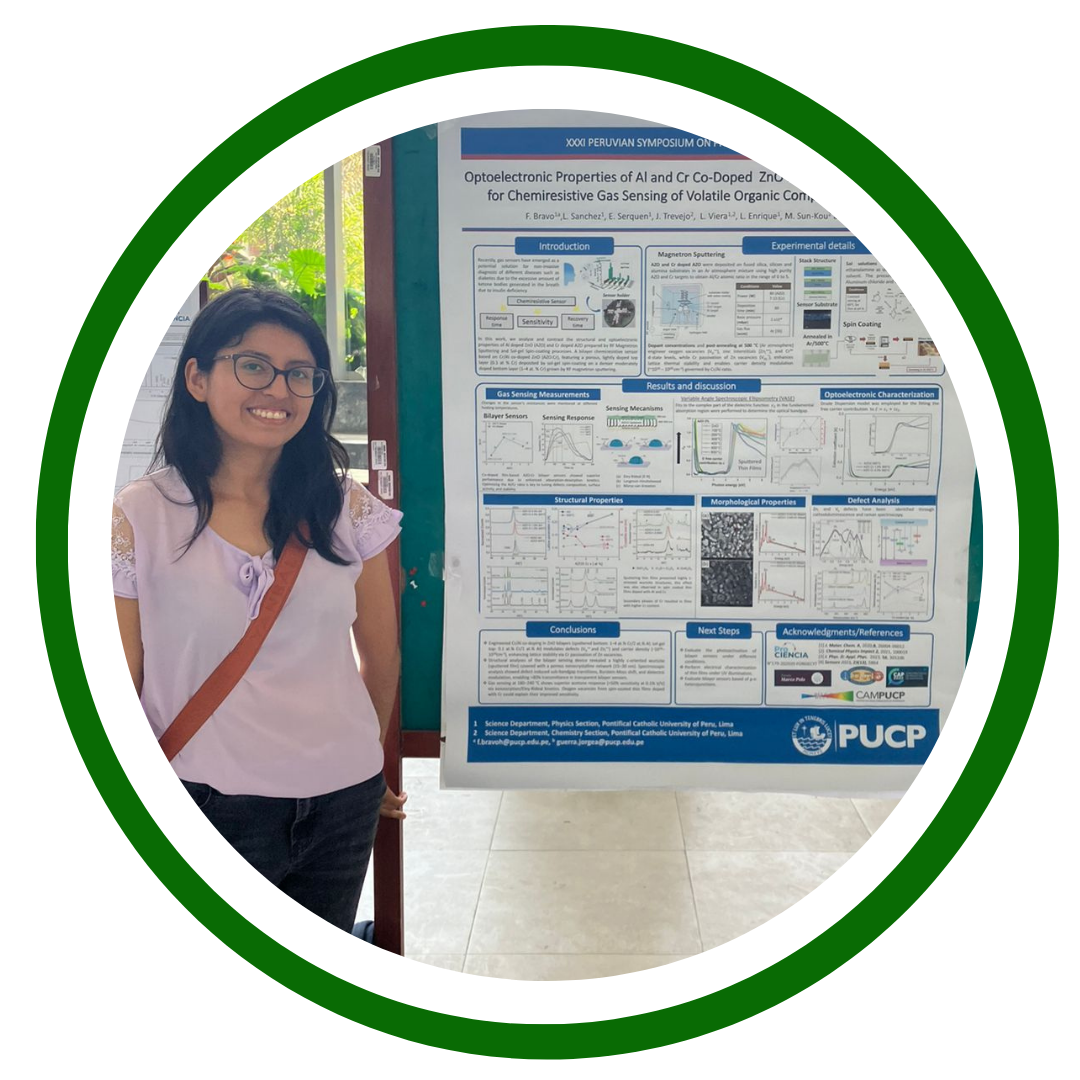
PhD candidate in Physics with a Bachelor’s and Master’s degree in Chemistry from the Pontifical Catholic University of Peru. Proficient in experimental approaches, including synthesis (Hydrothermal, sol-gel and RF Magnetron Sputtering) and characterization techniques (SEM, Raman, XRD, PL/CL and ellipsometry). Committed to advancing sustainable technologies and currently working with transparent conductive oxides such as AZO and ITO doped with transition metals and rare earths to develop multifunctional materials.
Master’s students
BSc. Rafael Pulido Del Pino

Researcher in the Power to X division of the MatER group – PUCP. My current research focuses on the electrochemical reduction of nitrate using faceted Cu₂O nanoparticles as catalysts. In particular, I investigate the influence of crystallographic orientation ((100) and (111) facets) on catalytic activity, selectivity, and reaction kinetics. My work involves the use of rotating disk electrode (RDE), electrochemical characterisation techniques and DFT to evaluate mass transport effects, charge transfer processes, and kinetic parameters, aiming to elucidate facet-dependent reaction mechanisms toward ammonia production.
Sebastian Huatuco
 Master’s student in Materials Engineering with experience in sputtering techniques for the growth of single-layer and multilayer thin films. Has also conducted Raman spectroscopy measurements for material characterization.
Alex Marcelo Giron Rojas

Master’s student in Physics and researcher in the Materials Science and Renewable Energies (MatER) group at PUCP. My work focuses on the development and study of transparent conducting oxides (TCOs)
Fernando
 Master’s student in Physics and researcher in the Materials Science and Renewable Energies (MatER) group at PUCP. My work focuses on the development and study of transparent conducting oxides (TCOs), covering both thin-film growth and their structural, optical, and electrical characterization and analysis. In particular, I have worked with systems such as Zn-doped In₂O₃ (ZIO) and ZnO, and I am currently focused on IGZO, aiming to understand and optimize its performance for optoelectronic applications.
Undergraduate students
Samik Yanque Amable
I am a physics graduate and early-career researcher in the Materials Science and Renewable Energies (MatER) group at PUCP–Peru. My current work focuses on developing and understanding high-mobility zinc-doped indium oxide (ZIO) thin films grown by low-power RF sputtering for use as transparent conducting electrodes in perovskite/silicon tandem solar cells. I am particularly interested in how soft-sputtering processes at room temperature can enable stable, high-movility TCOs compatible with sensitive photovoltaic cells.