
Foot prostheses face significant adaptability challenges on irregular surfaces, since many conventional designs lack structures that enhance this capability. Evaluating their performance under these conditions typically requires specialized equipment, user recruitment, and ethical protocol approval, which increases both cost and validation time.
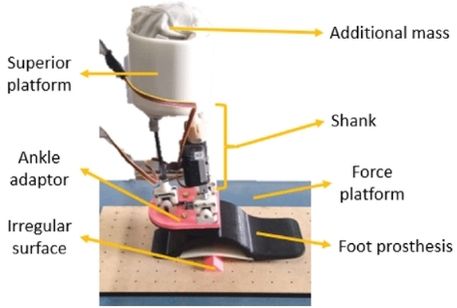
To address this, the study proposes an experimental methodology based on load tests under ISO 22675 category P5, combined with irregular-surface interaction tests, as a preliminary filter to identify promising designs before in vivo testing.
In the load tests, the design achieved a return energy above 92% across all gait phases (heel strike, mid-stance, and toe-off), along with a stiffness of 62.15 kN/m and 1.91 kNm/rad at toe-off—values comparable to LP Vari-Flex prostheses. It also showed 95% greater heel stiffness than commercial prostheses.
Meanwhile, the irregular-surface tests revealed that larger obstacles increase the ankle compensatory angle while reducing the support polygon length. However, further testing is needed to assess how load affects these variables, since the applied 15 N did not allow full deformation of the elastic element, potentially limiting the results.
Autor(es):Lagones, Marco
Abarca, Victoria E.
Elias, Dante A.
Año: 2025
Título de la revista: IEEE Xplore
Ciudad: Lima, Perú
Url: https://doi.org/10.1109/AMATHE65477.2025.11081280