
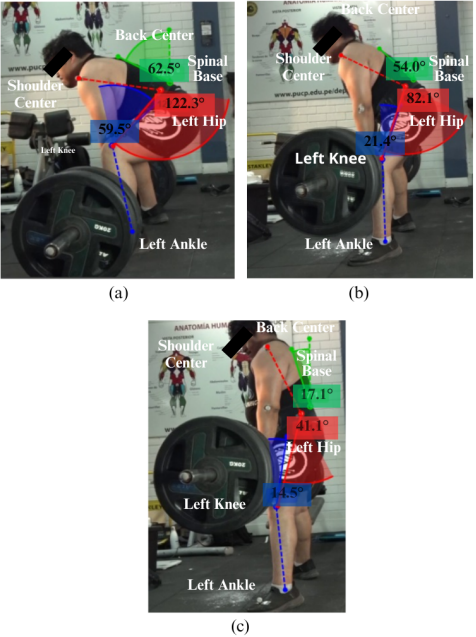
This study compares the conventional and sumo deadlift techniques under different load conditions, integrating kinematic and electromyographic (EMG) analysis to identify biomechanical differences. The results show that the biceps femoris is the primary contributor to force production at an individual level, while the thoracolumbar fascia exhibits the greatest amplitude and power across participants. Kinematic analysis revealed that the conventional deadlift involves larger ranges of motion for the hip and back, increasing mechanical demands and stability requirements. Limitations, such as temporal offsets in EMG signals and sensor positioning errors, were identified, emphasizing the need for advanced tools to enhance accuracy. These findings provide insights to optimize training protocols, improve performance, and minimize injury risks.
Autor(es):
Alberto G. Woll; John M. de Moura; Diego A. Cuba; Alexis Palomino; Victoria E. Abarca
Año: 2025
Título de la revista: IEEE Xplore
Ciudad: Shivamogga, India
Página inicial - Página final: 1-6
Url: https://ieeexplore.ieee.org/document/11080740/