
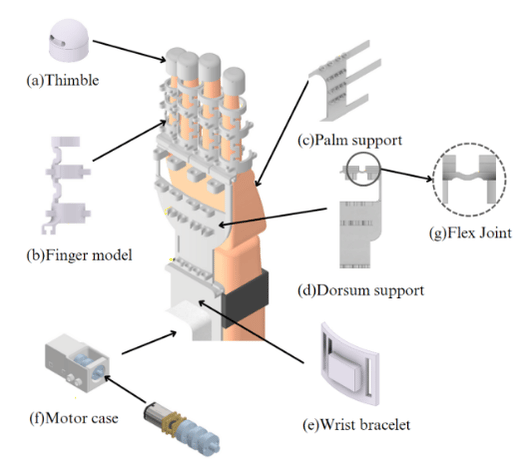
This paper presents a modular soft hand exoskeleton with an interactive interface designed to assist in rehabilitating individuals with spinal cord injuries experiencing hand spasticity. Following a Human-Centered Design (HCD) approach, the development process began with identifying and analyzing user needs, progressing through iterative phases of modeling, simulation, fabrication, and testing. The exoskeleton achieves a finger range of motion (ROM) of approximately 181.7°, closely natural hand movements while maintaining a lightweight design of 96 grams. Its modular and portable architecture allows for adaptation to different hand sizes, enhancing accessibility. The system was evaluated through an interactive game developed for therapy sessions, demonstrating functionality and usability. Preliminary results demonstrate promising potential for hand rehabilitation, and future work will focus on refining the design and validating its effectiveness on a larger scale. This work offers a practical and adaptable solution for hand rehabilitation in individuals with spinal cord injuries, contributing to the ongoing progress in rehabilitation technologies.
Autor(es):Arias, Danna I.
Elias, Dante A.
Año: 2025
Título de la revista: IEEE Xplore
Ciudad: Lima, Perú
Url: https://doi.org/10.1109/ICMRE64970.2025.10976325