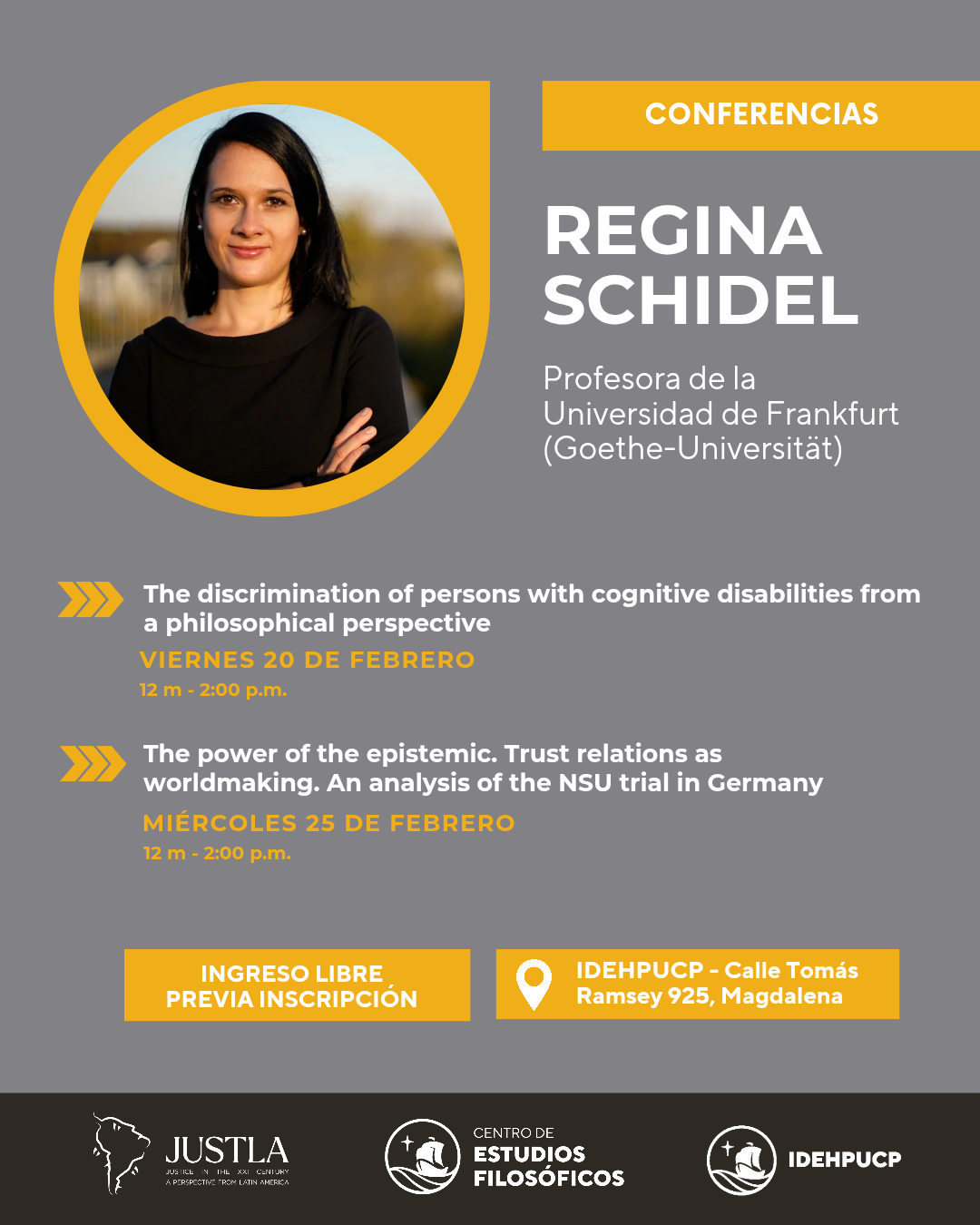
El Instituto de Democracia y Derechos Humanos de la PUCP (IDEHPUCP), el Centro de Estudios Filosóficos de la PUCP y el Consorcio “JUSTLA” (“Justice in the XXI Century: A Perspective from Latin America”) organizan las conferencias que ofrecerá la filósofa Regina Schidel, profesora de la Universidad de Frankfurt (Goethe-Universität), cuyas investigaciones abordan problemáticas de derechos humanos y discapacidad, la confianza social, la epistemología feminista y política, y las teorías de la injusticia epistémica.
Fechas: 20 y 25 de febrero
Hora: 12:00-14:00 h
Lugar: IDEHPUCP (Calle Tomás Ramsey 925, Magdalena)
Ingreso libre, previa inscripción
Dr. Regina Schidel is a lecturer at Goethe University Frankfurt, Germany. Her research focuses on human dignity and human rights, Critical Theory, the philosophy of disability, and feminist epistemology. Her dissertation, Relationality of Human Dignity. Addressing the justice theoretical status of humans with cognitive disabilities (2023), was published by Campus Verlag in the series Theorie und Gesellschaft. Her second book, published by Suhrkamp Verlag in 2025, develops a theory of ableism from both a philosophical and a social-theoretical perspective. Her current research project explores questions of social trust and hope, engaging with theories in feminist and political epistemology as well as theories of epistemic injustice.
Lecture 1 | Viernes 20 febrero, 12:00-14:00 h
The discrimination of persons with cognitive disabilities from a philosophical perspective
People with intellectual disabilities pose a challenge to conventional philosophical theories of personhood, dignity, and legal subjectivity, as these are often bound to a rationalist paradigm. The lecture critically examines such ableist tendencies in philosophy and explores alternative philosophical resources capable of resisting the discrimination of people with intellectual disabilities.
Lecture 2 | Miércoles 25 febrero, 12:00-14:00 h
The power of the epistemic. Trust relations as worldmaking. An analysis of the NSU trial in Germany
In this presentation, I argue that relations of trust and mistrust possess epistemic power. More specifically, (mis-)attributions of trustworthiness or credibility toward members of oppressed and marginalized groups— “epistemic injustices”—function as practices of problematic conceptual representation that reinforce structural hierarchies. As such, they block and impede societal trust relations and thereby emancipatory worldmaking. To substantiate this claim, I draw on the investigations and trial surrounding the NSU (National Socialist Underground) in Germany in the 2000s.