
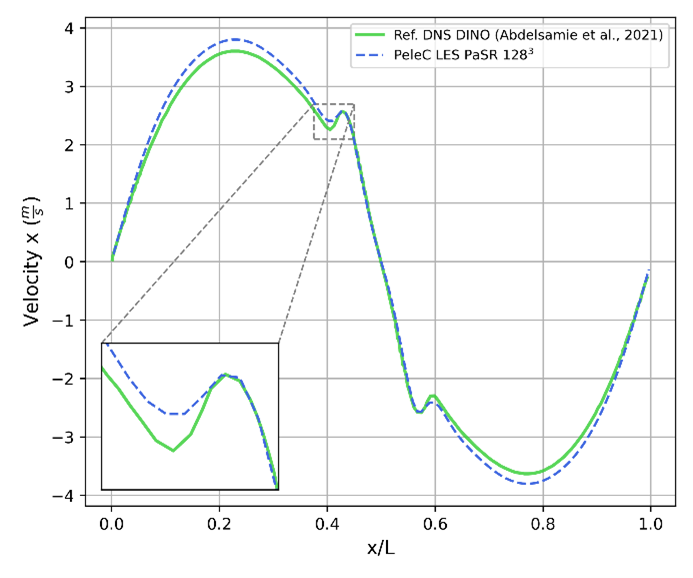
In combustion systems such as those used in rotating detonation engines (RDE), turbulence chemistry interactions (TCI) play a key role. Accordingly, the main goal of this work is to assess a partially stirred reactor (PaSR) based combustion model that allows modeling the referred TCI interactions. PaSR-based models represent indeed a computationally affordable alternative compared to other combustion models, while still accounting for detailed finite-rate chemistry. The capabilities of a PaSR-based combustion model are assessed in this work accounting for a reactive Taylor-Green vortex (TGV) flow configuration. More specifically, all numerical simulations are performed using a high-fidelity computational fluid dynamics (CFD) tool known as PeleC. This CFD tool solves the Navier-Stokes transport equations accounting for a reactive compressible flow. Closure of the set of transport equations solved is achieved using a large eddy simulation (LES) based approach and a combustion model based on chemical reactors. The numerical results obtained in this work using the PaSR-based combustion model evaluated here are compared in terms of temperature, heat release, velocity, and species mass fractions against direct numerical simulations (DNS) related results. Overall, the numerical results obtained here using LES and the implemented PaSR-based combustion model highlight that they are comparable with the DNS ones accounted for as reference here.
Autor(es):RUIZ, Sebastian
VALENCIA, Sebastian
CELIS, Cesar
MENDIBURU, Andres
BRAVO, Luis
KHARE, Prashant
Año: 2024
Título de la revista: ASME 2024 International Mechanical Engineering Congress and Exposition IMECE2024
Ciudad: Portland, Oregon, USA