
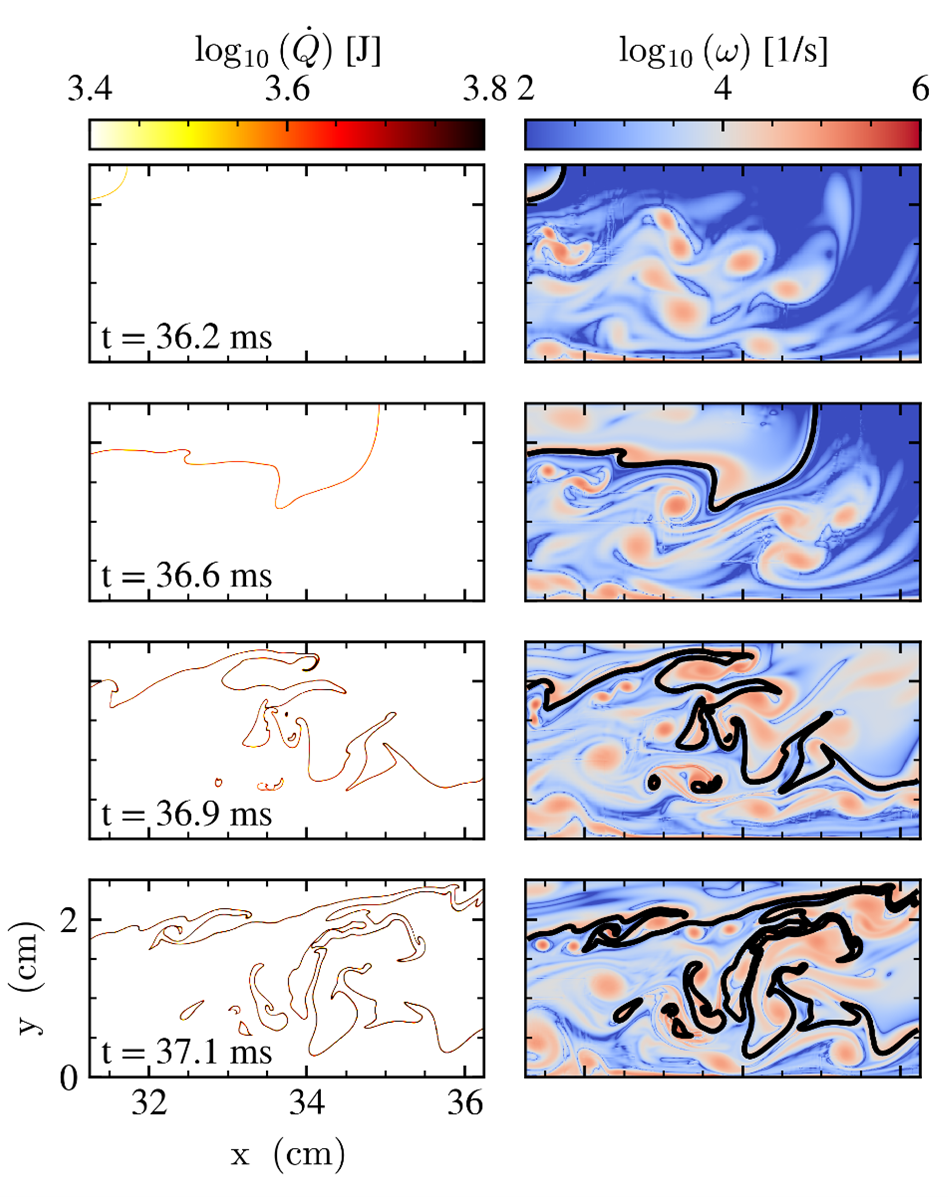
Flame acceleration plays an important role in determining the onset of deflagration-to-detonation transition (DDT) phenomenon that is relevant to novel pressure-gain propulsion and explosion safety research. Accordingly, this work explores the influence of the separation distance between obstacles (S) inside a 1050 mm closed duct on the acceleration of premixed flames fueled by a stoichiometric methane/air mixture at 40 kPa pressure. The studied duct geometry features a 96 mm x 96 mm square cross section and includes five obstacles along the wall with a 75% blockage ratio, each delineated by side dimensions of 96 mm x 96 mm and square holes of 48 mm x 48 mm. Experimental and direct numerical simulations (DNS) techniques are employed here to investigate the flame acceleration dynamics under different operating conditions. More specifically, high-speed video captures the dynamics of the flame front evolution from experiments, while DNS are carried out using the PeleC fully compressive Navier Stokes solver, including finite-rate chemistry and adaptive mesh refinement (AMR). A comparison between experimental and numerical results for S = 1.0 Dₕ shows reasonable agreement in flame tip velocity and reduced position, supporting the applicability of a two-dimensional DNS model like the one employed here. In contrast, for S = 1.5 Dₕ the numerical results fail to reproduce the experimentally observed flame structure and acceleration, likely due to missing three-dimensional effects. Numerical simulations for different S values ranging from 0.75 to 1.5 Dₕ reveal that obstacle spacing has a strong influence on flame acceleration mechanisms. As S increases indeed, the flame shifts from geometry-constrained jetting to instability-driven propagation involving vortex generation and pressure-wave interactions. The case with S = 1.25 Dₕ yields the highest flame tip velocity, even though the one with S = 1.5 Dₕ exhibits greater vorticity and pressure amplitudes. This is attributed to the reduced flame–vortex coupling coherence in the S = 1.5 Dₕ case, which results in more chaotic flame dynamics and lower flame acceleration efficiency. These results offer new insight into the mechanisms of flame acceleration under confinement and highlight obstacle spacing as a key design parameter for optimizing performance and safety in combustion systems.
Autor(es):VALENCIA, Sebastian
ILLACANCHI, Fernando
De Azevedo, Lucas
MENDIBURU, Andres
BRAVO, Luis
KHARE, Prashant
CELIS, Cesar
Año: 2025
Título de la revista: Flow, Turbulence and Combustion
Volumen: 115
Página inicial - Página final: 1729 - 1753
Url: https://doi.org/10.1007/s10494-025-00691-2