
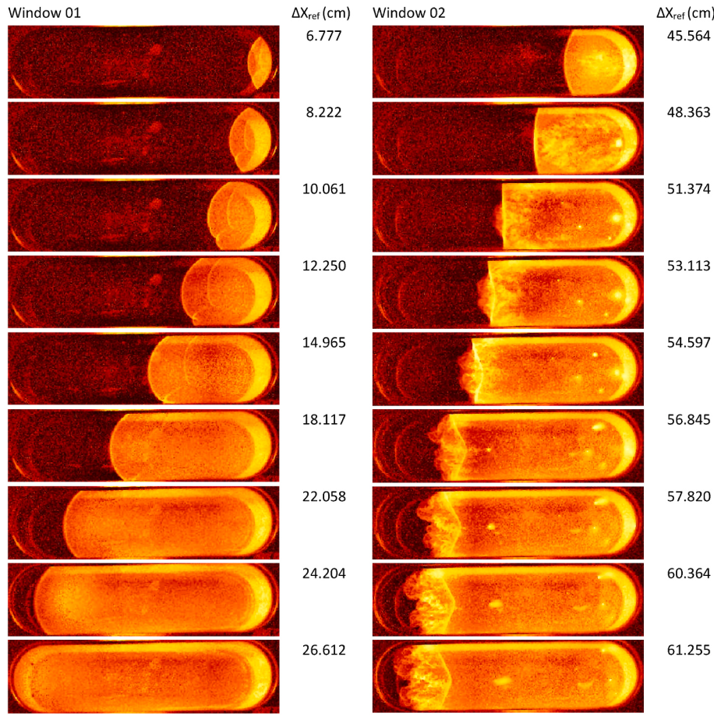
This experimental study investigates the influence of perforated plate orifice diameter on the flame extinction for propane mixtures enriched with hydrogen, under initial conditions of 40 kPa and 295 K. Six mixtures were analyzed, characterized by their thermo-diffusive properties, represented by the dimensionless Lewis (Le: 0.72 to 1.97) and Zeldovich (Ze: 4.98 to 7.07) numbers, as well as the Damköhler (Da: 12.68 to 17.23), Prandtl (Pr: 0.566 to 0.727) and Peclet (Pe) numbers. To induce significant variations in Le number, helium was incorporated into selected mixtures. The experiments employed acrylic perforated plates with four different orifice diameters (1.0, 2.0, 2.6, and 3.2 mm), and to evaluate their effectiveness, the blockage ratio (BR = 71 %) was kept constant across all configurations. Each mixture was tested in four replicates per configuration, totaling 96 flame propagation experiments. The results indicate that mixtures with Le < 1 generate more reactive flame fronts, with earlier onset of flat and tulip flame structures. Additionally, lower values of Le and Ze correlate with higher flame propagation velocities, reaching a maximum of 53.88 m/s, as do higher Da and Pe values, and lower Pr values. This behavior is attributed to the high mass diffusivity of H2, its low activation energy, and the abundant formation of highly reactive radicals, which promote rapid flame front expansion and greater thermal stability. These factors hinder flame extinction. Finally, it is concluded that reducing the orifice diameter significantly enhances flame extinction effectiveness, establishing perforation diameter as a critical parameter in the design of industrial flame suppression systems.
Autor(es):MARIÑOS, Diego
NZINGA, Manuel
MARIÑES, Manuel
QUISPE, Luis
PAZ, Edgar
CELIS, Cesar
MENDIBURU, Andres
Año: 2025
Título de la revista: International Journal of Hydrogen Energy
Volumen: 160
Número: 150588
Url: https://doi.org/10.1016/j.ijhydene.2025.150588