
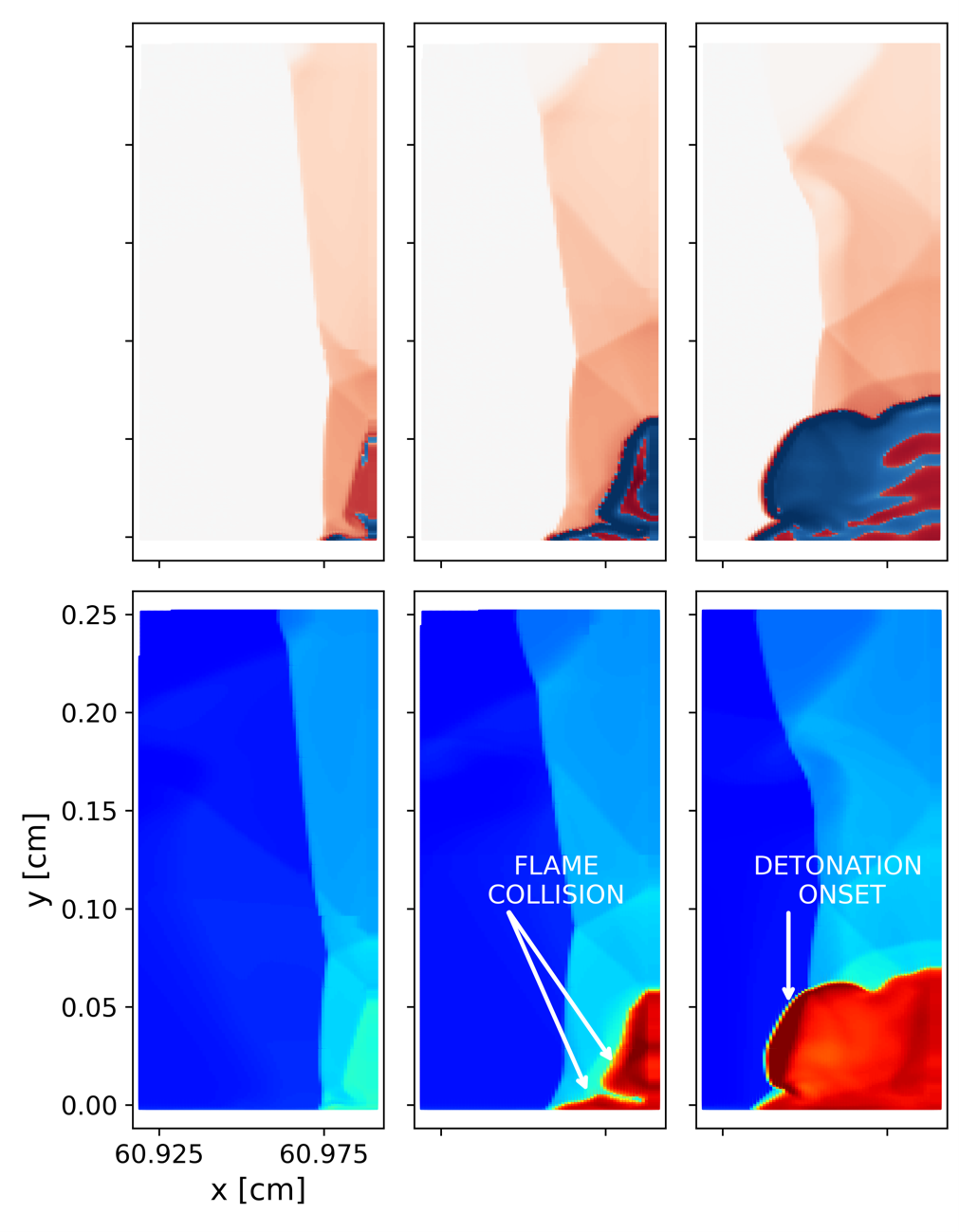
This work investigates the onset of detonation via deflagration-to-detonation transition (DDT) in a canonical flow configuration involving a closed channel with rectangular obstacles. By analyzing thermodynamic variables, such as thermicity and irreversible entropy generation, the role of shock–obstacle interactions in preheating the gas mixture at obstacle corners and enhancing chemical reactions is highlighted. The results comprise analyses of three relevant scenarios: no-autoignition (Case A), detonation onset (Case B), and deflagration onset (Case C). The results reveal a sequence of events leading to detonation initiation, consisting of Mach stem formation, flame autoignition, radical species cloud formation, and detonation onset. Flame autoignition triggered via the Mach stem mechanism is characterized by high chemical activity following the shock–obstacle interaction. Entropy generation analysis indicates in turn that the Mach stem region is a highly reactive zone coupled to the local pressure field. Nevertheless, flame autoignition alone does not guarantee detonation onset. The numerical results obtained here show that detonation occurs only when a chemically active environment surrounds the autoignited flame. Particularly, elevated production rates of radical species such as O and H are observed ahead of the flame front. These findings provide numerical evidence supporting the SWACER (shock wave amplification by coherent energy release) mechanism and establish a mechanistic framework linking local thermicity and radical species production to flame autoignition and detonation onset in DDT processes.
Autor(es):ILLACANCHI, Fernando
MENDIBURU, Andres
CELIS, Cesar
Año: 2026
Título de la revista: Proceedings of the Combustion Institute
Volumen: 42
Número: 106568
Url: https://doi.org/10.1016/j.proci.2026.106568