
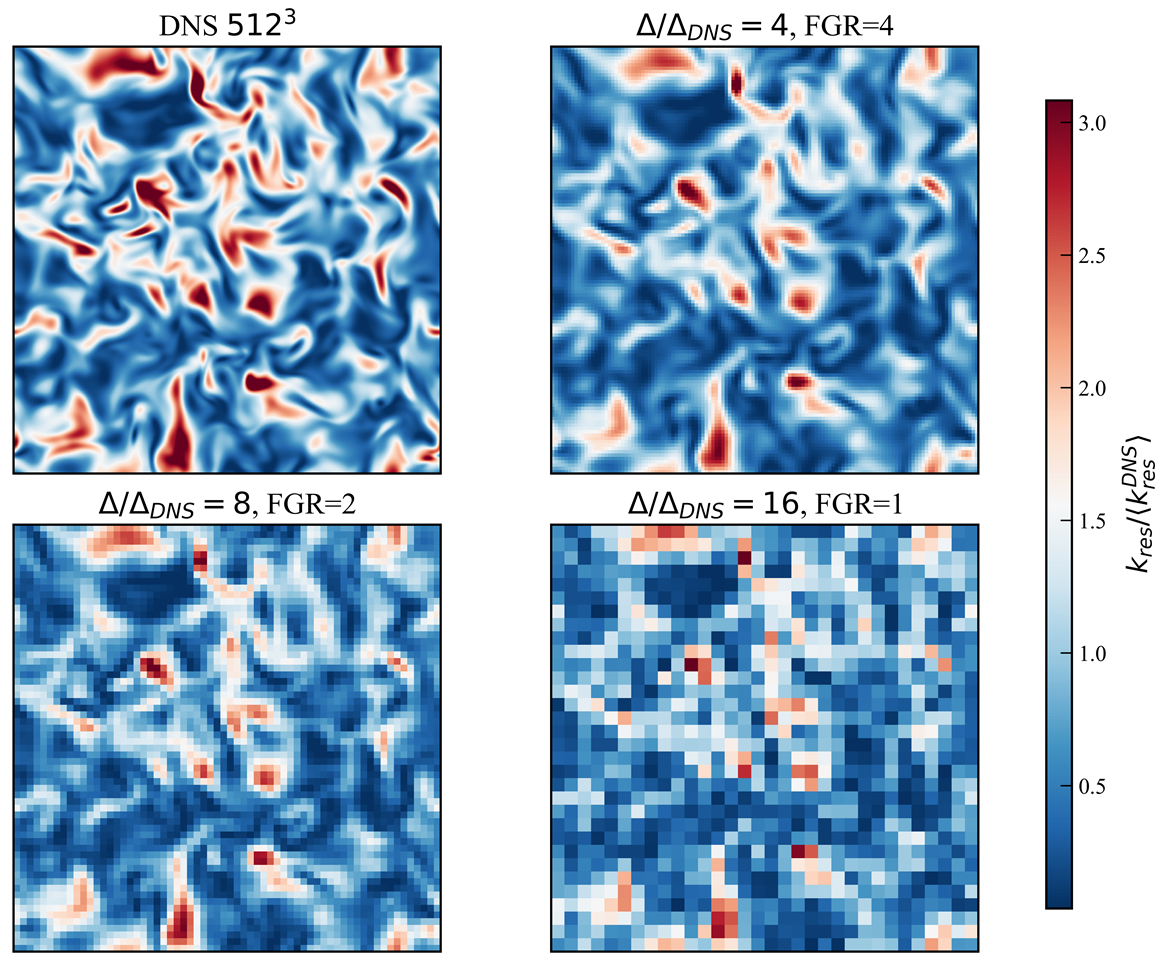
This study presents an a priori evaluation of deconvolution-based sub-filter scale (SFS) models for the turbulent stress tensor in large eddy simulation (LES) of compressible homogeneous isotropic turbulence. The assessed closures include the approximate deconvolution model (ADM), the direct deconvolution model (DDM), the discrete direct deconvolution model (D3M), and the dynamic iterative approximate deconvolution (DIAD) model. These approaches reconstruct unfiltered flow variables from spatially filtered data, enabling direct estimation of unresolved SFS stresses. Their performance is compared with classical closures, namely, the dynamic Smagorinsky model and the dynamic mixed model. High-resolution direct numerical simulation data are filtered using a top-hat kernel and downsampled to a coarser LES-like grid, after which an explicit Gaussian filter is applied to emulate an explicitly filtered LES framework. This methodology provides a stringent a priori assessment by accounting for filter attenuation and grid-truncation effects. Each deconvolution-based model is examined independently, including a systematic analysis of its parameters, and multiple filter-to-grid ratios re considered to quantify scale-separation effects. Model performance is assessed using correlation coefficients, relative errors, scatter plots, probability density functions, and power spectra of individual SFS stress components. The results show that deconvolution-based closures consistently outperform classical models, achieving higher correlations, lower reconstruction errors, and improved recovery of scale-dependent features. Indeed, DDM exhibits the highest reconstruction fidelity, while ADM, D3M, and DIAD show strong agreement with the reference stresses. These findings establish that deconvolution-based models are robust and physically consistent model closures for LES of compressible turbulent flows.
Autor(es):VALENCIA, Sebastian
CORDOVA, Jhon
MENDIBURU, Andres
BRAVO, Luis
KHARE, Prashant
CELIS, Cesar
Año: 2026
Título de la revista: Physics of Fluids
Volumen: 38
Número: 055101
Página inicial - Página final: 1-30
Url: https://doi.org/10.1063/5.0321479